The Level #122
| < 6 min
|
Welcome to The Level — This week, something unexpected forced a different kind of leadership work.
|
|
|
|
|
I flew to Sonoma to spend two days working with my executive coach,Therese Miclot. And I woke up Friday morning without a voice.
Not hoarse. Completely gone. I couldn't whisper, couldn't laugh, couldn't make a single sound come out of my throat. My vocal cords had just — stopped. So there I was, supposed to spend the day doing deep leadership work, and I'm texting from across the table, holding up my phone with questions typed into it, passing my Notes app back and forth like we're in high school.
And Therese, without a single moment of awkwardness or discomfort, just met me right there. Warm, patient, completely at ease with the strange logistics of the situation. We worked through an entire day of it and I left having done some of the most meaningful thinking I've done in a while about where I'm going, who I need to become to get there, and what I actually need to let go of.
If you've been following along on LinkedIn this week, you've seen me talking about some of this — the RCC framework, the HEAR Me™ concept, the in-person work I've been investing in this year. Here's the fuller version of what's been on my mind. | |
| I am genuinely obsessed with this question right now: what does it actually take for a founder and CEO to grow into the next version of themselves?
Not tactically — we have plenty of great tactical thinking happening at Level Up. I mean at the human level. The internal work. The kind that, in my experience, doesn't happen from content, doesn't happen from frameworks, and doesn't happen from AI, no matter how good the prompt is.
I use AI constantly. I think it's one of the most powerful productivity tools I've ever had access to and I'm not slowing down on it. But here's what I keep noticing: AI is a positive feedback loop. When you bring your thinking to it, it validates you. It helps you develop the idea. It tells you you're onto something — even, honestly, if you're not. Even when you explicitly ask it to challenge you, it doesn't do it with the surgical precision and incisiveness that a skilled human being can bring when they really know you. It doesn't have the pattern recognition. It doesn't have the history.
| |
What Therese did that Friday — while I sat there literally unable to speak — was exactly that. She pulled the thread I wasn't pulling myself. She named the thing I was dancing around. She did it with warmth and precision in a way that a tool simply cannot replicate.
And I've been sitting with this broader observation ever since: I think there are two growth curves running in opposite directions right now. AI capability is compounding fast. So is the genuine human craving for real connection, real coaching, real accountability. Not as a reaction to AI, necessarily — though maybe partly that — but because there is something irreplaceable about being in the room with someone who knows you and gives a damn about where you're going.
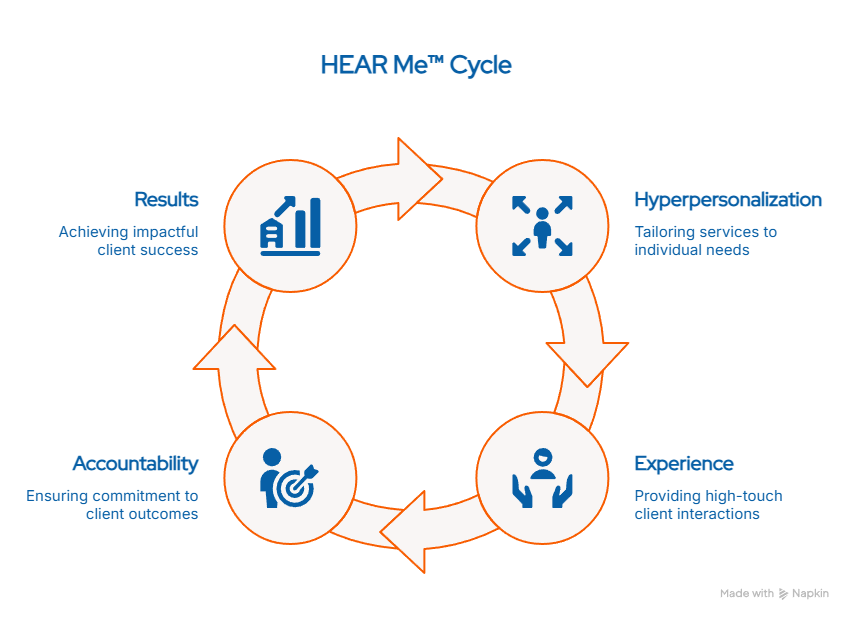
That's the HEAR Me™ framework I've been building out. Hyperpersonalization, Experience, Accountability, Results. Four things that differentiate high-ticket, high-touch work from everything else — including everything AI can produce. This is why our clients pay us six figures. I need to know them with an incredible amount of depth to translate any framework into something that actually works for their specific situation. Content can't do that. A tool can't do that. A person who's invested in your outcome can. |
 |
 |
|
|
|
So here's the question I want to leave you with, whether you're building a consulting practice or leading one.
Who is that person in your corner right now? Not a peer who cheers you on. Not a mastermind where you get twenty minutes in the hot seat every few weeks. Someone who is specifically invested in your growth, knows your history, understands your patterns, and will tell you the hard thing when the hard thing is what you need to hear.
And if you are that person for your clients — look at your own HEAR score. Are you actually hyperpersonalizing your work, or are you delivering a good framework that could apply to anyone? Are you creating an experience, or just a service? Are you holding people accountable in a way that costs something when they slip? Are results the non-negotiable at the center of everything you do?
Those are the questions worth sitting with. Not because they're uncomfortable, but because the answers are the difference between a practice that compounds and one that just treadmills. |
|
My voice is mostly back. I still don't know exactly what happened — whether it was stress, travel, something I need to look into more seriously. Therese was characteristically gracious about the whole situation, which is, I think, the best possible advertisement for the kind of work she does.
But I keep going back to that day and thinking about the container she held — with no friction, no awkwardness, just complete presence and care — even when the logistics were genuinely strange. That's what you're building when you go all-in on the human side of your work. Not just a service. Not just a deliverable. A container people trust when things get weird and hard and not what anyone planned. That's worth something. That's worth a lot, actually.
Reply and tell me — who is your Therese right now? | |
To building something that doesn’t reset every month, - Amanda
P.S. Cohort 5 of the MRR Accelerator launches May 12th. We're capped at 8 and a couple of spots are already spoken for. If the question "who's helping me become who I need to become" doesn't have a clear answer right now, the link in my bio is a good place to start. | | Enjoying The Level?
Forward it to a founder who’s ready to build a business that runs on systems, not stress. Want your own copy each week?
Subscribe to The Level |
|
|
|
|
|
|
|